If you are looking to secure a six-figure salary in IT, a cloud certification is no longer an optional resume booster—it is a mandatory baseline. The cloud computing market in 2026 continues its aggressive expansion, but the dynamics of hiring have matured. Hiring managers now assume candidates have either hands-on cloud experience or a certification. Ideally, they want both.The two undisputed giants of the industry remain Amazon Web Services (AWS) and Microsoft Azure. AWS currently maintains approximately 31% of the global cloud infrastructure market share, while Azure follows closely at roughly 25%.Because both platforms dominate the enterprise landscape, tech professionals constantly face the same dilemma: Which certification track offers the highest salary and the fastest return on investment?This guide breaks down the true financial value of AWS and Azure certifications in 2026, helping you choose the path that aligns with your specific career goals.Why Cloud Salaries Remain Sky-High in 2026The reason cloud certifications command such high salaries comes down to simple economics: demand continues to outpace the supply of truly qualified engineers. While thousands of entry-level candidates hold basic foundational certificates, there is a severe shortage of mid-level and senior professionals who can actually design, secure, and optimize complex cloud environments.Companies are willing to pay a premium—often between $130,000 and $180,000 annually—because a skilled cloud architect can save a business tens of thousands of dollars a month by optimizing server usage and preventing catastrophic security breaches. The salary gap between non-certified and certified IT professionals is widest at the mid-career level (3 to 5 years of experience), where advanced certifications act as a gatekeeper for senior management roles.AWS vs. Azure: 2026 Salary BreakdownThe entry-level certifications for both platforms (AWS Cloud Practitioner and Azure Fundamentals) will help you land a job, but they will not make you wealthy. The massive salary jumps happen when you achieve the “Associate” and “Professional/Expert” tiers.Here is the average base salary comparison for 2026 across the United States:Certification LevelAWS CertificationAverage SalaryAzure CertificationAverage SalaryEntry-Level / FoundationalAWS Cloud Practitioner$96,000Azure Fundamentals (AZ-900)$92,000Intermediate / AssociateAWS Solutions Architect – Associate$144,000Azure Administrator (AZ-104)$135,000Advanced / ProfessionalAWS Solutions Architect – Professional$175,000+Azure Solutions Architect Expert$170,000+Specialty (DevOps)AWS DevOps Engineer – Professional$155,000Azure DevOps Engineer Expert$148,000Note: These figures represent base salaries. Total compensation, including stock options and bonuses at major tech companies, frequently pushes the professional-tier salaries well past $200,000.Deep Dive: The AWS Certification PathAWS was the first major player in the cloud space, and it still holds the largest absolute number of job openings.Where AWS Dominates:Startups, digitally native tech companies, and organizations prioritizing a massive catalog of specialized microservices almost exclusively use AWS. If your goal is to work in Silicon Valley, for a fast-paced software startup, or in an intensive DevOps environment, AWS is your strongest move.The Highest ROI AWS Certification:The AWS Certified Solutions Architect – Associate (SAA-C03) is widely considered the most valuable mid-level certification in the entire IT industry. Hiring managers consistently rank it as the single best indicator that an engineer understands how to design distributed systems covering compute, storage, networking, and security. Deep Dive: The Azure Certification Path Microsoft Azure is growing at a slightly faster rate than AWS due to its seamless integration with tools companies already use, like Windows Server, Active Directory, and Microsoft 365.Where Azure Dominates: Fortune 500 enterprises, government agencies, healthcare systems, and traditional financial institutions lean heavily toward Azure. If you want a highly stable, lucrative career working in enterprise IT for massive, established corporations, Azure will open more doors than AWS. The Highest ROI Azure Certification: The Microsoft Certified: Azure Administrator Associate (AZ-104) is the gatekeeper for serious Azure careers. While AWS focuses heavily on architecture and design, Azure places a massive emphasis on administration, identity management (Entra ID), and governance. Passing the AZ-104 immediately qualifies you for dedicated cloud operations roles. The “Multi-Cloud Premium” Strategy The highest-paid engineers in 2026 do not choose between AWS and Azure—they master both. As enterprises grow, they avoid “vendor lock-in” by splitting their infrastructure. For example, a bank might use AWS for its web applications but rely on Azure for its internal corporate data and employee identity management. Industry data shows that engineers certified in two or more clouds earn an average of 15% to 25% more than single-platform specialists. An architect holding both the AWS Solutions Architect Professional and the Azure Solutions Architect Expert credentials routinely commands a base salary exceeding $195,000.If you have the time, the ultimate 2026 career strategy is: Master your primary cloud up to the Associate/Administrator level. Build 1-2 years of real-world experience. Obtain the foundational and associate certifications in the competing cloud. Frequently Asked Questions (FAQ)Which cloud certification is easiest for beginners? The Microsoft Azure Fundamentals (AZ-900) is generally considered slightly easier to pass than the AWS Certified Cloud Practitioner. The AZ-900 focuses more on broad cloud concepts and Microsoft’s licensing/pricing models, whereas AWS requires a bit more technical memorization of their specific services. Both can typically be passed with 40 to 60 hours of study.Do I need to know how to code to get a cloud certification? For foundational and architectural certifications, no. You need to understand how systems connect, but you do not need to write software. However, if you pursue the Developer or DevOps tracks (like the AWS DevOps Engineer Professional), strong scripting skills in Python, Bash, or PowerShell are absolutely mandatory.How much does it cost to get certified? The exams themselves are relatively inexpensive. Entry-level exams cost roughly $100, while Professional-level exams cost up to $300. The true cost is your study materials. Relying entirely on free documentation works, but investing $30 to $50 in high-quality video courses and practice exams from platforms like Udemy or specialized cloud academies is highly recommended to ensure you pass on the first attempt.
Blogs
The Ultimate Guide to the Best Applicant Tracking Systems (ATS) for Small Businesses in 2026
For small businesses, hiring is no longer just about finding the right candidate—it is about doing it efficiently before your competitors do. If your Human Resources (HR) team is still using spreadsheets, manual email chains, and disconnected job board logins to track applicants, you aren’t just losing top-tier talent; you are actively losing money.An Applicant Tracking System (ATS) is a specialized software application that automates the administrative heavy lifting of recruiting. It handles everything from posting to multiple job boards simultaneously, parsing resumes for keywords, scheduling interviews, and sending legally compliant offer letters. For a small to mid-sized business (SMB), transitioning to cloud-based HR software is the absolute fastest way to reduce your overall cost-per-hire and shorten your time-to-fill metrics.This comprehensive guide will break down exactly how much manual recruiting is costing your business, what features you must look for in modern HR software, and provide an in-depth review of the top ATS platforms dominating the market in 2026.The Hidden Cost of Manual RecruitingBefore choosing a software platform, it is critical to understand what your current manual process is actually costing you in recruiter hours and lost productivity. Calculating the hours spent reading unqualified resumes, emailing back and forth to schedule interviews, and manually posting to individual job boards adds up quickly.Consider the traditional workflow: An HR manager or small business owner writes a job description. They manually log into Indeed, LinkedIn, and ZipRecruiter to post it. They then receive 200 resumes via email. They must open every single PDF, scan it for relevant experience, manually reply to the top 10 candidates to find interview times, and track all of this on a shared Excel spreadsheet.If your HR manager makes $40 an hour, and they spend 15 hours managing the administrative logistics of a single hire, that is $600 in pure administrative cost—not including the cost of the job board listings themselves.A modern ATS automates up to 80% of this workflow. The software automatically screens out unqualified applicants, allows candidates to self-schedule interviews based on your synced calendar, and centralizes all communication into a single dashboard.Key insight: Because of the massive reduction in manual HR hours, most small businesses break even on their annual ATS investment after making just their second hire of the year.The “Build vs. Buy” Debate: Spreadsheets vs. SoftwareMany small businesses hesitate to invest in an ATS, assuming that a well-organized Google Sheet and a dedicated email inbox (like careers@yourcompany.com) are sufficient. This is the “Build” approach.When to stick with Spreadsheets:If your business only hires one to three entry-level employees per year, and you receive fewer than 20 applicants per role, you can likely survive without a dedicated ATS. At this low volume, the time spent setting up and learning a new software platform might outweigh the immediate benefits.When it is time to Buy an ATS:The breaking point usually occurs when a business reaches 15 to 20 total employees and begins hiring for specialized roles (like a Senior Accountant or a Marketing Director). At this stage, compliance, data privacy, and candidate experience become critical. If you are hiring five or more employees annually, or if you consistently receive over 50 applications per job posting, the lack of an ATS is actively damaging your employer brand. Candidates who do not hear back promptly will leave negative reviews on Glassdoor, making future recruiting even harder.Buyer’s Guide: What to Look for in a Small Business ATSNot all recruiting software is built equally, and enterprise-grade platforms are often too complex and expensive for small businesses. When evaluating an ATS in 2026, ensure the platform excels in these four critical areas: One-Click Job Syndication: The software must have the ability to distribute your job posting to premium job boards (Indeed, LinkedIn, Google Jobs, Glassdoor) with a single click. You should not have to pay extra for basic distribution.Automated Resume Parsing and AI Screening: Look for tools that use Artificial Intelligence to read resumes and automatically highlight candidates who meet your minimum requirements (e.g., specific certifications or years of experience).Seamless Calendar Integration: The biggest bottleneck in hiring is scheduling. Your ATS must integrate directly with Google Workspace or Microsoft 365, allowing candidates to view your recruiters’ open time slots and book their own interviews.Reporting and Compliance: The system should automatically generate Equal Employment Opportunity (EEO) reports and track your essential recruiting metrics, such as “Time to Hire” and “Source of Hire” (knowing exactly which job board brings in your best employees).Top 5 ATS Platforms Compared (2026)Here is how the top platforms for small to medium-sized businesses stack up based on features, pricing, and overall value.ATS SoftwareBest ForStarting Price (2026)Key FeatureWorkableFast, high-volume hiring$299/monthAI-powered candidate sourcingGreenhouseScaling startups~$500/month (Custom)Advanced structured interviewingBambooHRAll-in-one HR~$5-$8/employeeSeamless payroll integrationBreezy HRBudget-conscious teamsFree tier availableDrag-and-drop pipeline managementLeverProactive talent sourcingCustom pricingUnified CRM and ATS capabilities1. WorkableBest for: Businesses that need to fill roles immediately and want transparent pricing.Workable is an incredibly powerful platform designed to get job postings in front of as many eyes as possible. Its biggest strength is its distribution network. With one click, your job description is blasted out to over 200 premium and niche job boards globally. Workable also includes a massive database of over 400 million passive candidate profiles, and its built-in AI will proactively suggest candidates who match your job description, even if they haven’t applied yet. Pricing: The Standard plan starts at $299 per month, which includes the full ATS, AI sourcing, and integrated job boards. They are one of the few platforms offering a 15-day free trial without requiring a credit card. Pros: Setup takes less than a day. The mobile app for hiring managers allows you to review resumes and leave feedback while away from your desk.Cons: If you want premium add-ons like built-in video interviewing or SMS candidate texting, you have to pay extra monthly fees on the Standard plan. 2. GreenhouseBest for: High-growth startups focused on reducing bias through structured interviewing.Greenhouse is widely considered the gold standard for companies scaling rapidly. Instead of just tracking resumes, Greenhouse focuses on the methodology of hiring. It forces hiring managers to create structured interview “scorecards” before talking to candidates. This ensures every candidate is asked the exact same questions and evaluated on the exact same criteria, which drastically reduces unconscious bias and speeds up the decision-making process. Pricing: Greenhouse uses custom pricing based on company size, but minimum contracts typically start around $6,000 per year (averaging ~$500/month for small teams). Pros: Incredible reporting dashboards and industry-leading integration capabilities (over 400 native integrations with background check services, assessment tools, and HR tech).Cons: The pricing minimums make it too expensive for micro-businesses hiring fewer than 15 people a year. It also requires a cultural shift, as hiring managers must adopt the scorecard methodology.3. BambooHR Best for: Companies that want recruiting, onboarding, and payroll united in one system. If you do not want a standalone ATS and prefer an all-in-one Human Resources Information System (HRIS), BambooHR is the absolute winner for small businesses. It handles everything from the moment a candidate applies to the day they retire. When a candidate signs their digital offer letter, the software automatically transitions their data into the onboarding module, sets up their employee profile, and syncs them into the payroll system. Pricing: BambooHR charges per employee, typically ranging from $5 to $8 per employee per month, plus potential implementation fees. Pros: Eliminates duplicate data entry completely. You manage performance reviews, time-off requests, and recruiting in one clean dashboard.Cons: The ATS features are not as robust or customizable as dedicated platforms like Workable or Greenhouse.4. Breezy HRBest for: Micro-businesses and those needing a functional free option. Breezy HR is one of the very few premium ATS platforms that still offers a genuinely useful “Bootstrap” free tier. It utilizes a highly visual, drag-and-drop Kanban board interface (similar to Trello). This makes it incredibly intuitive for business owners and managers who have zero experience using professional HR software. You simply drag a candidate’s profile card from “Applied” to “Interviewing” to “Hired. “Pricing: The free tier allows one active job position at a time. Paid plans with unlimited positions and advanced features typically start around $149/month. Pros: Highly affordable, visually appealing, and requires zero technical training to deploy. Cons: The reporting features on the lower-tier plans are very basic compared to its competitors.5. Lever Best for: Niche hiring and headhunting specialized talent. Lever merges a traditional ATS with a Candidate Relationship Management (CRM) tool. This hybrid approach is ideal for hiring specialized, highly competitive roles (like senior software engineers or executive leadership). Often, these candidates are not actively looking for jobs. Lever allows you to build talent pools and nurture relationships with passive candidates over months or years until they are ready to make a career move. Pricing: Lever relies on custom pricing tailored to your organization’s exact needs, requiring a conversation with their sales team. Pros: Features an excellent Chrome extension that allows recruiters to import passive candidate profiles directly from LinkedIn into the Lever pipeline. Cons: The interface and the sheer number of features can feel overwhelming for companies that only do basic, high-volume entry-level hiring. Next Steps for Your HR Team Choosing the right software is only the first step in modernizing your recruitment strategy. To ensure you get the maximum return on investment (ROI) from your new ATS, your team needs to optimize your internal processes. First, rewrite your job descriptions. ATS algorithms rely on specific keywords to rank candidates. Ensure you clearly list required hard skills, certifications, and software proficiencies. Second, train your hiring managers. A software tool is only as good as the people using it. If your department heads refuse to log into the ATS to leave candidate feedback, you will still suffer from bottlenecks. Establish a clear policy that all hiring communication must live inside the platform, not in isolated email threads. Frequently Asked Questions (FAQ)What is the cheapest ATS for a small business? For businesses with zero budget, Breezy HR offers the best free tier, allowing you to manage one open role at a time. If you need to manage multiple roles, Worktable’s transparent $299/month Standard plan is highly competitive for the feature set provided, avoiding the massive annual lock-in contracts of enterprise systems. Does Google have a free Applicant Tracking System?Google does not have a dedicated, standalone ATS product. However, many small businesses use a combination of Google Forms (to collect applications), Google Sheets (to track status), and Google Workspace integration (for email and calendar) as a rudimentary, free alternative to an ATS. Additionally, “Google for Jobs” is a search feature that aggregates job postings, which most premium ATS platforms automatically syndicate to.How long does it take to implement a new ATS?Implementation time varies heavily by platform. Self-serve platforms like Workable and Breezy HR can be set up and actively receiving applications in less than 24 hours. More complex systems that require custom workflows, data migration from older systems, and methodology training (like Greenhouse or Lever) typically take 4 to 6 weeks for full deployment.Will an ATS automatically reject good candidates?Modern ATS platforms do not blindly “throw out” resumes. However, they do rank and filter candidates based on the parameters set by the recruiter. If a recruiter sets a mandatory requirement (e.g., “Must have a CPA license”) and the candidate’s resume does not explicitly state they have a CPA, the software will filter them into an unqualified tier. This is why optimizing job descriptions is crucial.
Online Interview Guide 2026: Complete Preparation Tips for Job Seekers
Online interviews have become one of the most common hiring methods across the world. Whether you are applying for jobs in Dubai, Qatar, Saudi Arabia, the UAE, or any other country, many companies now prefer virtual interviews before final hiring. Employers use platforms like Zoom, Google Meet, Microsoft Teams, Skype, and WhatsApp video calls to interview candidates quickly and efficiently.
For job seekers, online interviews can be both exciting and stressful. Unlike traditional face-to-face interviews, virtual interviews require technical preparation, professional communication skills, and a distraction-free environment. Many candidates lose opportunities because they fail to prepare properly for online interviews.
This complete Online Interview Guide will help you understand every step of the process. You will learn how to prepare for a virtual interview, what mistakes to avoid, what recruiters expect, and how to increase your chances of getting selected.
Why Online Interviews Are Becoming Popular
Companies are increasingly using online interviews because they save time, reduce travel costs, and make international hiring easier. Employers in the Gulf countries especially use virtual interviews to hire candidates from countries like Nepal, India, Pakistan, Bangladesh, Sri Lanka, and the Philippines.
Online interviews are now common for:
Hotel jobs
Supermarket jobs
Oil and gas jobs
Construction jobs
Restaurant jobs
Customer service roles
Office administration
Security jobs
Delivery jobs
Remote jobs
Recruiters can quickly evaluate communication skills, confidence, professionalism, and technical understanding through online meetings.
Types of Online Interviews
Understanding the different types of virtual interviews can help you prepare better.
- Video Call Interviews
These interviews happen live using video conferencing platforms such as Zoom or Google Meet. Recruiters ask questions in real time just like a physical interview.
- Phone Interviews
Some employers first conduct audio interviews before scheduling video interviews.
- Recorded Interviews
In this format, candidates record answers to pre-set questions. Recruiters review the recordings later.
- Chat-Based Interviews
Some companies conduct interviews through live chat or messaging platforms.
How to Prepare for an Online Interview
Preparation is the key to success. Many candidates think online interviews are easier than physical interviews, but recruiters still evaluate professionalism seriously.
Research the Company
Before attending the interview, research the company carefully. Learn about:
Company background
Services and products
Job responsibilities
Company culture
Office location
Work environment
Understanding the company helps you answer questions confidently.
Check Your Internet Connection
A stable internet connection is extremely important. Poor connectivity can interrupt conversations and create a bad impression.
Before the interview:
Test your Wi-Fi speed
Keep mobile data as backup
Sit near your router
Close unnecessary apps
If your internet disconnects during the interview, reconnect immediately and apologize professionally.
Choose a Quiet Environment
Your surroundings matter during a virtual interview.
Select a place that is:
Quiet
Well-lit
Clean
Professional-looking
Avoid noisy backgrounds, television sounds, traffic noise, or interruptions from family members.
A simple clean wall background works best.
Dress Professionally
Even though the interview is online, you should dress professionally as if attending a real office interview.
Recommended attire:
Formal shirt
Neat hairstyle
Clean appearance
Minimal accessories
Avoid casual clothing such as sleeveless shirts or overly bright outfits.
Professional dressing creates a positive first impression.
Test Your Camera and Microphone
Technical issues can ruin interviews. Before the interview starts:
Check your webcam
Test your microphone
Adjust camera angle
Ensure proper lighting
Your face should be clearly visible.
Avoid sitting in dark rooms or directly in front of bright windows.
Keep Your Resume Ready
Always keep these documents nearby:
Updated CV or resume
Passport copy
Certificates
Experience letters
Job description
Recruiters may ask questions based on your resume.
Common Online Interview Questions
Most online interviews include standard questions. Preparing answers beforehand improves confidence.
Tell Me About Yourself
This is usually the first question.
Your answer should include:
Your name
Educational background
Work experience
Skills
Career goals
Keep your introduction short and professional.
Why Do You Want This Job?
Recruiters want to know your motivation.
Good answers include:
Career growth
Learning opportunities
Interest in the company
Relevant skills
Avoid answering only for salary reasons.
What Are Your Strengths?
Mention strengths relevant to the job, such as:
Communication skills
Teamwork
Problem-solving
Time management
Customer service
Provide examples if possible.
What Are Your Weaknesses?
Choose a real weakness but explain how you are improving it.
Example:
“I sometimes overthink details, but I am learning better time management.”
Why Should We Hire You?
Highlight your:
Skills
Experience
Dedication
Work ethic
Positive attitude
Explain how you can contribute to the company.
Online Interview Tips for Freshers
Freshers often feel nervous because they lack work experience. However, companies also hire candidates based on attitude and potential.
Be Confident
Confidence matters more than perfect answers.
Speak clearly and maintain eye contact with the camera.
Focus on Skills
If you have no experience, discuss:
Academic projects
Internships
Volunteer work
Technical skills
Communication abilities
Practice Before the Interview
Conduct mock interviews with friends or family members.
Practice improves fluency and reduces nervousness.
Body Language During Online Interviews
Body language still matters in virtual interviews.
Maintain Eye Contact
Look at the camera instead of constantly looking at yourself on the screen.
This creates better engagement.
Sit Properly
Avoid lying down or sitting casually.
Sit upright with good posture.
Smile Naturally
A natural smile makes you appear confident and friendly.
Avoid Distractions
Do not:
Check your phone
Eat during interviews
Talk to others nearby
Move around excessively
Stay focused throughout the interview.
Mistakes to Avoid in Online Interviews
Many candidates lose opportunities because of simple mistakes.
Joining Late
Always join 10–15 minutes early.
Late arrivals create a negative impression.
Poor Audio Quality
Recruiters must hear you clearly.
Use headphones if necessary.
Reading Answers
Avoid reading prepared scripts directly from the screen.
Speak naturally.
Interrupting the Interviewer
Listen carefully and allow recruiters to finish speaking before responding.
Using Informal Language
Avoid slang words or overly casual communication.
Speak professionally.
Best Platforms Used for Online Interviews
Zoom
One of the most popular interview platforms worldwide.
Features:
Video meetings
Screen sharing
Recording options
Google Meet
Simple and easy-to-use platform for interviews.
Microsoft Teams
Widely used by corporate companies.
Skype
Still used by some international recruiters.
How to Answer Interview Questions Professionally
Professional communication increases selection chances.
Use Clear Sentences
Avoid overly complicated language.
Simple and clear answers work best.
Be Honest
Never provide fake experience or false information.
Recruiters often verify details.
Stay Positive
Even if discussing previous jobs, avoid speaking negatively about past employers.
Questions You Should Ask Recruiters
At the end of interviews, recruiters may ask:
“Do you have any questions for us?”
You can ask:
What are the job responsibilities?
What is the work schedule?
Is training provided?
What are the next hiring steps?
This shows interest and professionalism.
How to Reduce Nervousness Before Interviews
Interview anxiety is common, especially for first-time job seekers.
Practice Deep Preparation
Confidence comes from preparation.
Sleep Properly
Avoid staying awake late before the interview day.
Practice Speaking
Record yourself answering common questions.
This helps improve communication skills.
Stay Positive
Do not assume failure before the interview begins.
Online Interview Checklist
Before the interview starts, confirm the following:
Internet working properly
Camera tested
Microphone checked
Resume ready
Quiet environment
Professional clothing
Phone on silent mode
Interview link ready
Follow-Up After the Interview
After completing the interview:
Thank the recruiter
Check your email regularly
Respond professionally
Keep your phone available
Many companies send updates through email or WhatsApp.
Online Interview Tips for Gulf Jobs
Candidates applying for jobs in Dubai, Qatar, Saudi Arabia, and other Gulf countries should remember:
Keep passport ready
Mention Gulf experience clearly
Speak confidently in English
Be prepared for salary discussions
Understand visa and accommodation details
Recruiters in Gulf countries often value discipline, communication skills, and professionalism.
Importance of Communication Skills
Strong communication skills can make a huge difference during online interviews.
Employers evaluate:
Clarity
Confidence
Listening ability
Professional behavior
Improving communication skills increases hiring opportunities significantly.
How Recruiters Evaluate Candidates Online
Recruiters usually assess:
Appearance
Confidence
Technical knowledge
Communication
Attitude
Punctuality
Problem-solving ability
Even small details can influence hiring decisions.
Final Thoughts
Online interviews are now a major part of the global hiring process. Whether you are applying for hotel jobs, supermarket jobs, office jobs, or remote jobs, knowing how to handle virtual interviews professionally is extremely important.
Preparation, confidence, communication skills, and professionalism can significantly increase your chances of getting hired. By following this complete Online Interview Guide, you can avoid common mistakes and perform better during virtual interviews.
Always remember:
Prepare properly
Dress professionally
Practice common questions
Stay confident
Follow up after interviews
Success in online interviews comes from preparation and positive communication. The more interviews you attend, the more confident and experienced you will become.
Latest Jobs in Qatar for Freshers in 2026 – Salary, Benefits & How to Apply
Qatar continues to be one of the top destinations for job seekers looking for better salaries, tax-free income, and international work experience. Every year, thousands of freshers from countries like Nepal, India, Bangladesh, Pakistan, Kenya, and the Philippines travel to Qatar for employment opportunities in different sectors.
In 2026, the demand for workers in Qatar remains strong due to ongoing infrastructure projects, hospitality expansion, transportation development, retail growth, and increasing tourism. The country offers jobs for both skilled and unskilled workers, making it an attractive option for freshers who want to start their careers abroad.
If you are searching for the latest jobs in Qatar for freshers, this guide will help you understand available positions, expected salaries, benefits, visa processes, and tips to apply safely.
Why Freshers Prefer Working in Qatar
Many freshers choose Qatar because it offers several advantages compared to local job markets in many countries.
- Tax-Free Salary
One of the biggest benefits of working in Qatar is the tax-free salary system. Employees usually receive their full salary without income tax deductions, helping workers save more money.
- Free Accommodation and Food
Many companies in Qatar provide:
Free accommodation
Transportation
Medical insurance
Food allowance
Overtime opportunities
This helps workers reduce expenses and increase savings.
- High Demand for Workers
Qatar regularly hires workers in sectors such as:
Construction
Hospitality
Airport services
Security
Warehousing
Cleaning services
Retail
Delivery services
Freshers with little or no experience can still find opportunities.
- International Experience
Working in Qatar gives employees international exposure and valuable work experience that can improve future career opportunities.
Latest Jobs in Qatar for Freshers in 2026
Here are some of the most popular job categories currently hiring freshers in Qatar.
- Construction Jobs
Construction remains one of the largest employment sectors in Qatar.
Popular Positions
Helper
Mason
Carpenter
Steel fixer
Electrician
Plumber
Painter
Tile worker
Average Salary
QAR 1,200 to QAR 3,500 per month depending on skills and experience.
Benefits
Free visa
Accommodation
Overtime pay
Transportation
Construction jobs are suitable for physically fit individuals willing to work on infrastructure and building projects.
- Airport Jobs in Qatar
Airport jobs are becoming increasingly popular among freshers because of attractive salaries and modern work environments.
Common Airport Positions
Baggage handler
Cleaner
Customer service assistant
Security staff
Trolley collector
Cargo helper
Average Salary
QAR 2,000 to QAR 5,000 monthly.
Skills Needed
Basic English communication
Good behavior
Teamwork skills
Airport jobs may also include rotational shifts and overtime opportunities.
Airport Jobs Salary in Qatar
Airport jobs often pay better than many entry-level positions in other industries.
Here is an estimated salary breakdown:
Job Position Monthly Salary
Baggage Handler QAR 2,000 – QAR 3,000
Airport Cleaner QAR 1,800 – QAR 2,500
Security Staff QAR 2,500 – QAR 4,000
Customer Service Assistant QAR 3,000 – QAR 5,000
Cargo Worker QAR 2,200 – QAR 3,500
Some companies also provide:
Free uniforms
Annual leave
Flight tickets
Health insurance
- Warehouse Jobs in Qatar With Free Visa
Warehouse jobs are ideal for freshers because they often require minimal experience.
Responsibilities
Packing products
Loading and unloading
Inventory handling
Sorting goods
Scanning packages
Average Salary
QAR 1,800 to QAR 3,200 per month.
Common Benefits
Free visa
Accommodation
Transportation
Overtime
Warehouse jobs are available in:
Retail companies
Logistics firms
Food supply companies
E-commerce warehouses
Workers with forklift experience may receive higher salaries.
- Hotel and Hospitality Jobs
Qatar’s tourism and hospitality industry continues to grow rapidly.
Entry-Level Hotel Jobs
Waiter
Housekeeping staff
Kitchen helper
Reception assistant
Bellboy
Cleaner
Average Salary
QAR 1,800 to QAR 4,500 monthly.
Employees in hospitality may also receive:
Tips
Service charges
Free meals
Good communication skills can help candidates secure better hospitality jobs.
- Security Guard Jobs
Security companies regularly hire freshers for malls, offices, hotels, and residential buildings.
Requirements
Basic English
Physical fitness
Clean background
Salary
QAR 2,000 to QAR 4,000 monthly.
Some employers may prefer candidates with:
Security training
GCC experience
Driving license
- Delivery Driver Jobs
The rise of food delivery and online shopping has increased demand for delivery workers.
Popular Roles
Food delivery rider
Courier driver
Bike delivery staff
Salary
QAR 2,500 to QAR 6,000 depending on incentives and deliveries completed.
Requirements
Valid driving license
Smartphone usage
Basic navigation skills
Top Companies Hiring in Qatar
Several large companies and contractors regularly recruit workers.
Industries Hiring Frequently
Construction companies
Hotels and resorts
Airlines and airports
Retail chains
Logistics companies
Facility management firms
Before applying, candidates should:
Verify company details
Read job descriptions carefully
Avoid fake recruitment agencies
Never pay large illegal fees for jobs.
How to Apply for Jobs in Qatar
Applying for jobs in Qatar has become easier through online platforms and recruitment agencies.
Step 1: Prepare Your CV
Your CV should include:
Personal information
Education
Skills
Experience (if any)
Passport details
Contact information
Keep your CV simple and professional.
Step 2: Search for Verified Jobs
Use trusted:
Company websites
Recruitment agencies
Job portals
Social media pages
Always verify the legitimacy of recruiters.
Step 3: Attend Interviews
Some companies conduct:
Online interviews
Video interviews
Walk-in interviews
Basic communication and confidence can improve your chances.
Step 4: Medical and Documentation
Selected candidates may need:
Medical tests
Passport verification
Police clearance
Visa processing
Ensure all documents are genuine and valid.
Skills That Increase Your Chances of Getting Hired
Even freshers can improve job opportunities by learning basic skills.
Useful Skills Include
Basic English communication
Computer knowledge
Customer service
Driving
Electrical skills
Plumbing
Warehouse handling
Short training courses may increase salary offers.
Work Culture in Qatar
Qatar has a multicultural work environment where employees from many countries work together.
Important Workplace Tips
Respect company rules
Be punctual
Follow safety guidelines
Maintain professional behavior
Workers who perform well may receive:
Promotions
Contract extensions
Salary increases
Cost of Living in Qatar
Although salaries in Qatar are attractive, understanding living expenses is important.
Common Monthly Expenses
Food
Mobile recharge
Transportation
Personal shopping
Workers receiving free accommodation and transport can save a significant portion of their income.
Tips to Avoid Job Scams
Unfortunately, fake job offers are common online.
Warning Signs
Asking for large payments
No official contract
Fake visa promises
Poor communication
No company address
Always verify:
Company registration
Official email addresses
Recruitment licenses
Never share sensitive financial information with unknown recruiters.
Can Freshers Get Jobs in Qatar Without Experience?
Yes, many companies hire freshers for entry-level roles.
Jobs that commonly accept freshers include:
Helpers
Cleaners
Warehouse workers
Hospitality staff
Delivery assistants
Construction labor
However, learning additional skills can increase salary opportunities.
Future Job Opportunities in Qatar
Qatar’s economy continues to grow through:
Tourism
Real estate
Retail
Logistics
Technology
Transportation
This creates ongoing employment opportunities for international workers.
Candidates who improve their skills and maintain professional work ethics can build long-term careers in Qatar.
Final Thoughts
Qatar remains one of the best destinations for freshers looking for international job opportunities in 2026. With tax-free salaries, company benefits, and strong demand across multiple industries, workers can improve their financial future while gaining valuable global experience.
Whether you are interested in construction jobs, airport jobs, warehouse positions, hospitality roles, or delivery work, there are many opportunities available for motivated candidates.
Before applying, always research companies carefully, prepare a professional CV, and avoid fraudulent recruiters. Safe and verified applications can help you start your career journey successfully in Qatar.
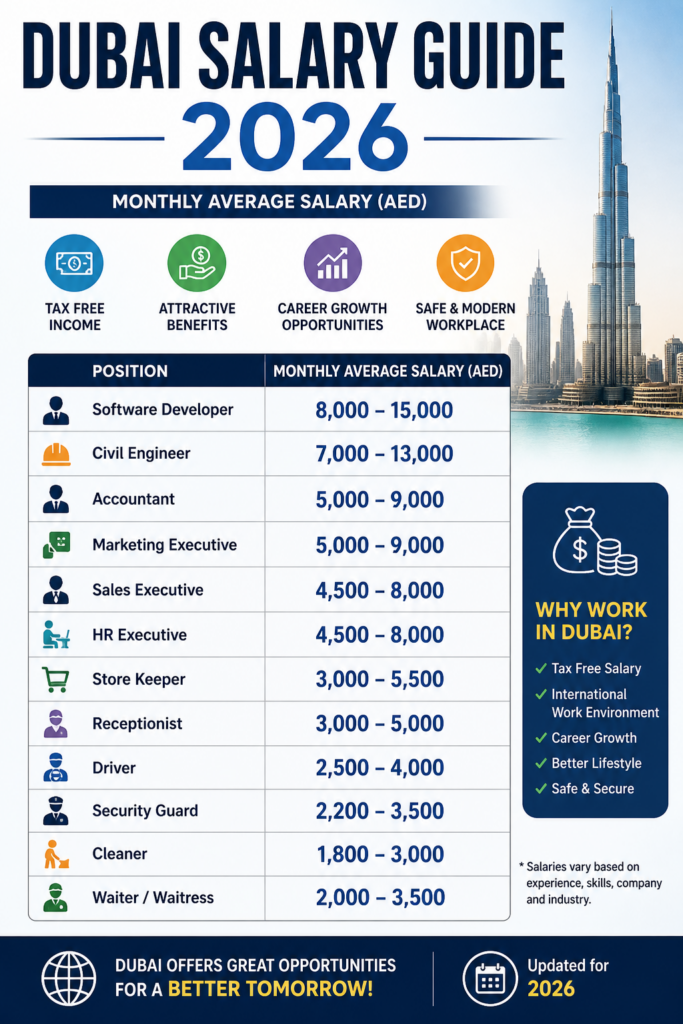
Salary Breakdown for Every Job in Dubai (2026 Updated)
Dubai, one of the fastest-growing cities in the Dubai, continues to attract job seekers from across the world. With tax-free salaries, modern infrastructure, and strong job demand across industries, it remains a top destination for employment in 2026. However, one of the most common questions job seekers ask is: “How much can I really earn in Dubai?”
This detailed salary breakdown will help you understand real earning potential across different industries, including entry-level roles, mid-level jobs, and high-paying professional positions. Whether you are a fresher or experienced worker, this guide will give you a clear picture of Dubai salaries in 2026.
Why Understanding Salary in Dubai is Important
Before applying for jobs, it’s essential to know:
Expected salary range
Living costs
Benefits included (accommodation, food, transport)
Many job seekers make the mistake of accepting offers without understanding the complete compensation package.

Average Salary in Dubai (2026 Overview)
In 2026, the average monthly salary in Dubai varies widely depending on skill level:
Entry-level jobs: AED 1,200 – AED 4,000
Skilled workers: AED 4,000 – AED 10,000
Professionals: AED 10,000 – AED 30,000+
However, these numbers depend heavily on the industry, experience, and company.
🏢 1. Construction & Labor Jobs Salary
This sector hires a large number of workers from South Asia.
Common Jobs & Salaries:
Helper / General Labor: AED 900 – AED 1,500
Mason: AED 1,200 – AED 2,000
Electrician: AED 1,500 – AED 2,500
Plumber: AED 1,500 – AED 2,500
Heavy Driver: AED 2,500 – AED 4,000
Benefits:
Free accommodation
Transportation
Medical insurance
👉 These jobs usually offer lower salaries but include basic living support.
🛒 2. Supermarket & Hypermarket Jobs
Retail jobs are among the most popular for freshers.
Salary Breakdown:
Sales Associate: AED 1,800 – AED 2,800
Cashier: AED 2,000 – AED 3,000
Store Helper: AED 1,200 – AED 1,800
Supervisor: AED 3,500 – AED 5,000
Additional Benefits:
Overtime pay
Staff discounts
Accommodation (in some cases)
🍽️ 3. Hotel & Restaurant Jobs
The hospitality industry in Dubai is always hiring.
Common Roles:
Waiter/Waitress: AED 1,800 – AED 3,000
Housekeeping Staff: AED 1,200 – AED 2,200
Chef (Commis): AED 2,500 – AED 4,500
Kitchen Helper: AED 1,200 – AED 1,800
Hotel Receptionist: AED 2,500 – AED 4,000
Extra Earnings:
Tips (very important income source)
Service charges
🛢️ 4. Oil & Gas Jobs Salary
One of the highest-paying industries in the UAE.
Salary Range:
Helper: AED 1,500 – AED 2,500
Technician: AED 4,000 – AED 8,000
Engineer: AED 10,000 – AED 25,000+
Safety Officer: AED 6,000 – AED 12,000
Benefits:
Free food & accommodation
Rotation shifts
Travel allowance
🏦 5. Banking & Finance Jobs
Highly competitive but well-paying sector.
Salary Examples:
Bank Teller: AED 4,000 – AED 7,000
Customer Service Executive: AED 5,000 – AED 8,000
Accountant: AED 6,000 – AED 12,000
Financial Analyst: AED 10,000 – AED 20,000
👉 Requires education and experience.
🏢 6. Office & Admin Jobs
Suitable for graduates and experienced workers.
Salary Range:
Office Assistant: AED 2,500 – AED 4,000
Data Entry Operator: AED 2,500 – AED 4,500
HR Executive: AED 5,000 – AED 10,000
Admin Manager: AED 8,000 – AED 15,000
🚗 7. Driver Jobs in Dubai
Driving jobs are in high demand.
Salary Breakdown:
Light Vehicle Driver: AED 2,000 – AED 3,500
Delivery Driver: AED 2,500 – AED 4,500
Heavy Bus Driver: AED 3,000 – AED 5,500
Extras:
Incentives (especially for delivery jobs)
Fuel and vehicle provided
🧹 8. Cleaning & Housekeeping Jobs
Entry-level roles with basic requirements.
Salary:
Cleaner: AED 1,000 – AED 1,800
Housekeeping Staff: AED 1,200 – AED 2,200
Benefits:
Accommodation
Transportation
🛍️ 9. Sales & Marketing Jobs
Performance-based income is common.
Salary Range:
Sales Executive: AED 3,000 – AED 6,000
Real Estate Agent: Commission-based (AED 10,000+)
Marketing Executive: AED 5,000 – AED 12,000
👉 Commission can significantly increase income.
💻 10. IT & Tech Jobs (High Paying Sector)
Growing rapidly in 2026.
Salary Breakdown:
IT Support: AED 4,000 – AED 8,000
Web Developer: AED 6,000 – AED 15,000
Software Engineer: AED 10,000 – AED 25,000+
Cybersecurity Expert: AED 15,000 – AED 35,000
💸 Cost of Living in Dubai (Important)
Understanding expenses is crucial to evaluate salary.
Average Monthly Costs:
Shared accommodation: AED 500 – AED 1,500
Food: AED 500 – AED 1,000
Transport: AED 200 – AED 400
👉 If your job includes accommodation, you can save more.
📊 Salary vs Savings Reality
Let’s break it down:
Example (Low Salary Job):
Salary: AED 1,500
Expenses: AED 800
Savings: AED 700
Example (Mid-Level Job):
Salary: AED 4,000
Expenses: AED 2,000
Savings: AED 2,000
👉 Your savings depend more on expenses than salary.
🎯 Tips to Get Higher Salary in Dubai
Improve your English communication
Gain basic computer skills
Apply through trusted job portals
Avoid agents asking for high fees
Build a strong CV
⚠️ Common Salary Mistakes to Avoid
Accepting jobs without reading contract
Ignoring overtime policies
Not checking accommodation details
Falling for fake high salary offers
🔍 Final Thoughts
Dubai offers opportunities for everyone—from freshers to professionals. However, the key to success is understanding the real salary structure, benefits, and living costs before making a move.
If you plan smartly, even a small salary can help you build savings and grow your career in Dubai.
📌 FAQs
Q1: What is the minimum salary in Dubai in 2026?
There is no fixed minimum wage, but most entry-level jobs start from AED 1,000 to AED 1,500.
Q2: Which job has the highest salary in Dubai?
Jobs in IT, oil & gas, and finance sectors offer the highest salaries.
Q3: Can I save money with a low salary?
Yes, if accommodation and food are provided, savings are possible.
Q4: Is overtime paid in Dubai?
Yes, most companies pay overtime as per UAE labor law.
How to Prepare for a Job Interview in Dubai (Complete Guide for Job Seekers 2026)
Dubai has become one of the top destinations for job seekers looking for better salaries, tax-free income, and career growth. However, landing a job here is not easy. Competition is high, and employers expect candidates to be well-prepared, professional, and skilled.
If you are planning to apply for jobs in Dubai, then understanding how to prepare for interviews and creating the right CV is essential. This guide will walk you through everything you need to know—from building a strong CV to cracking your interview confidently.
Why Interview Preparation Matters in Dubai
Employers in Dubai receive hundreds of applications daily. Therefore, they shortlist only candidates who stand out.
Proper preparation helps you:
Make a strong first impression
Answer questions confidently
Show professionalism and cultural awareness
Increase your chances of getting hired faster
Without preparation, even qualified candidates often fail to secure jobs.
Step 1: Understand the Dubai Job Market
Before attending any interview, research the job market.
Key industries hiring in Dubai include:
Hospitality and hotels
Construction and engineering
Oil and gas
Retail and supermarkets
Banking and finance
Customer service and call centers
Each industry has different expectations. For example, hospitality jobs focus on communication skills, while construction roles emphasize experience and certifications.
Step 2: Create a Professional Dubai-Style CV
Your CV is the first thing recruiters see. A poorly written CV can cost you the job before the interview even starts.
Best CV Format for Dubai Jobs
A professional CV in Dubai should include:
Personal Information
Full name
Phone number (active WhatsApp preferred)
Email address
Nationality
Visa status
Professional Summary
A short paragraph highlighting your experience and skills.
Work Experience
Job title
Company name
Duration
Key responsibilities
Skills
Focus on job-relevant skills such as:
Communication
Customer service
Technical skills
Education
Certifications (if any)
Important CV Tips for Dubai
Keep your CV 1–2 pages only
Use a clean and simple format
Avoid spelling mistakes
Add a professional photo (recommended in UAE)
Customize your CV for each job
A well-optimized CV increases your chances of getting interview calls significantly.
Step 3: Prepare for Common Interview Questions
Most interviews in Dubai follow a structured format. Here are some common questions you should prepare for:
Tell me about yourself
Why do you want to work in Dubai?
What are your strengths and weaknesses?
Why should we hire you?
Describe your previous work experience
Pro Tip:
Always answer confidently and keep your responses short and relevant.
Step 4: Dress Professionally
Your appearance matters a lot in Dubai interviews.
Recommended Dress Code:
Formal shirt and trousers
Blazer (optional but recommended)
Clean shoes
Groomed hair
Avoid casual clothing like jeans, t-shirts, or slippers.
Step 5: Understand Workplace Culture in Dubai
Dubai is a multicultural city, and employers value professionalism and respect.
Important things to remember:
Be punctual (arrive 10–15 minutes early)
Maintain eye contact
Speak politely
Avoid negative comments about previous employers
Step 6: Improve Your Communication Skills
Communication is one of the most important skills in Dubai jobs.
To improve:
Practice speaking English daily
Watch interview videos
Record yourself answering questions
Work on confidence and clarity
Even basic English with confidence can impress recruiters.
Step 7: Ask Smart Questions
At the end of the interview, employers may ask if you have any questions.
You can ask:
What are the job responsibilities?
What is the work schedule?
Are there growth opportunities?
This shows your interest in the job.
Step 8: Follow Up After the Interview
Many candidates ignore this step, but it can make a difference.
Send a short message or email thanking the interviewer. This leaves a positive impression and increases your chances of selection.
Common Mistakes to Avoid
Avoid these mistakes if you want to succeed:
Going unprepared
Sending a generic CV
Arriving late
Speaking too much or too little
Lack of confidence
Not researching the company
Bonus Tips to Get Jobs Faster in Dubai
If you want to increase your chances:
Apply daily to multiple jobs
Use job portals and websites
Attend walk-in interviews
Network with people already working in Dubai
Keep updating your CV
Consistency is the key to success.
How This Guide Helps You Get High-Paying Jobs
By following these steps, you:
Improve your interview performance
Increase your job selection chances
Stand out among other applicants
Attract better salary opportunities
Employers prefer candidates who are prepared and professional.
Conclusion
Getting a job in Dubai is competitive, but not impossible. With the right preparation, a strong CV, and confidence, you can secure a good job quickly.
Focus on improving your skills, preparing for interviews, and applying consistently. Success will follow.
UK Skilled Worker Visa Jobs (2026): High-Salary Careers, Sponsorship & How to Secure a Job Fast
The UK Skilled Worker visa has become one of the most searched pathways for professionals looking to earn in pounds and build a stable international career. With thousands of UK employers actively sponsoring foreign workers, this route opens doors to some of the highest-paying and most secure jobs in the country.
In this guide, you’ll discover the best UK visa sponsorship jobs, expected salaries, industries with the highest demand, and proven strategies to get hired faster.
What is the UK Skilled Worker Visa?
The Skilled Worker visa allows foreign professionals to work in the UK with an approved employer. To qualify, you typically need:
A job offer from a licensed UK sponsor
A role that meets the required skill level
A minimum salary threshold (varies by job)
This visa is one of the most reliable ways to secure long-term employment in the UK.
Why Skilled Worker Visa Jobs Pay More
Jobs that offer visa sponsorship usually:
Have skill shortages in the UK
Require specialized expertise
Offer competitive salaries to attract global talent
This makes them highly valuable—and often higher paying than average roles.
Top High-Paying UK Visa Sponsorship Jobs (2026)
- IT & Tech Jobs (Highest Demand Sector)
Average Salary: £60,000 – £130,000+
Top Roles: Software Engineer, DevOps Engineer, Data Scientist
Why High CPC: Tech keywords attract premium advertisers
Tech remains the #1 sector for visa sponsorship due to ongoing digital transformation.
- Healthcare Jobs (Fastest Hiring Sector)
Average Salary: £50,000 – £120,000+
Top Roles: Doctors, Nurses, Radiographers
Demand Level: Extremely high
The UK healthcare system consistently hires international professionals.
- Engineering Jobs (Stable & High Income)
Average Salary: £45,000 – £100,000+
Top Fields: Civil, Electrical, Mechanical
Infrastructure and energy projects drive strong demand for engineers.
- Finance & Accounting Jobs
Average Salary: £55,000 – £140,000+
Top Roles: Financial Analyst, Accountant, Risk Manager
Finance roles—especially in London—offer some of the highest salaries.
- Teaching Jobs (Growing Opportunities)
Average Salary: £30,000 – £65,000+
Subjects in Demand: Math, Science, Computer Science
Teachers in shortage subjects are increasingly eligible for sponsorship.
Companies That Sponsor Work Visas in the UK
Many large UK employers are licensed sponsors, including:
Tech companies
Healthcare institutions
Financial firms
Engineering companies
Always verify sponsorship eligibility before applying.
How to Get a UK Visa Sponsorship Job Fast
- Target Shortage Occupations
Focus on roles listed in the UK’s shortage occupation list.
- Apply to Licensed Sponsors Only
Check if the company is approved to sponsor visas.
- Tailor Your CV for UK Standards
Keep it concise
Highlight achievements
Use measurable results - Use High-Authority Job Platforms
Apply through trusted websites and company career pages.
- Prepare for Interviews
Understand UK work culture and practice common interview questions.
High-Income Skills That Increase Selection Chances
To stand out, develop:
Cloud computing & DevOps
Cybersecurity
Data analysis & AI
Healthcare specialization
Financial modeling
These skills not only increase hiring chances but also boost salary offers.
Salary vs Cost of Living in the UK
London: Highest salaries, highest expenses
Other Cities: Better savings potential
Choosing the right city can significantly impact your financial growth.
Pro Tips to Maximize Your Earnings
Apply early to high-demand roles
Negotiate salary once you receive an offer
Gain certifications before applying
Focus on industries with high advertiser demand (tech, finance, insurance)
Final Thoughts
The UK Skilled Worker visa remains one of the most powerful pathways to high-paying international careers. By targeting high-demand sectors, building valuable skills, and applying strategically, you can secure a well-paying job with long-term growth potential.
Disclaimer
This content is for informational purposes only. Visa rules, salary thresholds, and job availability may change. Always check official UK government sources before applying.
Work From Home Jobs in the UK (2026): High-Paying Remote Careers & How to Apply
Remote work has transformed the UK job market, creating new opportunities for professionals to earn competitive salaries from anywhere. Whether you’re looking for flexibility, extra income, or a full-time remote career, the UK offers a wide range of high-paying work-from-home jobs.
This guide explores the best remote jobs in the UK, salary expectations, and how to get hired—even as an international applicant.
Why Remote Jobs in the UK Are Growing Fast
The shift to digital workplaces has made remote jobs more common across industries like tech, marketing, finance, and customer support.
Key advantages:
Work from anywhere (including outside the UK in some roles)
Lower living expenses
Flexible schedules
Access to global companies
Best High-Paying Remote Jobs in the UK
- Remote Software Developer
Average Salary: £50,000 – £110,000+
Skills Required: Python, JavaScript, cloud computing
Why it pays well: High global demand - Digital Marketing Specialist
Average Salary: £35,000 – £80,000+
High CPC Niches: SEO, PPC advertising, email marketing
Professionals skilled in paid advertising and SEO often earn more due to direct impact on business revenue.
- Online Financial Consultant
Average Salary: £45,000 – £100,000+
Skills Required: Financial planning, investment analysis
Finance-related remote roles typically offer higher RPM due to advertiser demand.
- Remote Project Manager
Average Salary: £40,000 – £90,000+
Certifications: PMP, Agile
Project managers are essential for coordinating distributed teams.
- Freelance Content Writer / Copywriter
Average Salary: £25,000 – £70,000+
High Paying Niches: Finance, insurance, tech
Writers in high-value niches can earn significantly more per project.
- Virtual Assistant
Average Salary: £20,000 – £50,000+
Tasks: Email management, scheduling, admin work
A good entry point for beginners looking to start working remotely.
High-Income Skills That Boost Remote Earnings
To increase your earning potential, focus on:
Search Engine Optimization (SEO)
Pay-Per-Click Advertising (PPC)
Data Analytics
UI/UX Design
Cloud Computing
These skills attract high-paying clients and employers.
How to Get a Remote Job in the UK
- Build In-Demand Skills
Take online courses and certifications in high-paying fields.
- Create a Strong Portfolio
Showcase your work, especially for freelance or creative roles.
- Use Trusted Platforms
Apply through reputable job boards and company websites.
- Optimize Your CV & LinkedIn
Highlight remote work experience and measurable results.
- Start Freelancing
Platforms like Upwork and Fiverr can help you gain experience and income.
Tips to Maximize Your Income
Choose high-CPC niches like finance, tech, and insurance
Work with international clients paying in stronger currencies
Upskill continuously
Negotiate your rates confidently
Final Thoughts
Remote jobs in the UK offer excellent earning potential and flexibility for both beginners and experienced professionals. By focusing on high-demand skills and applying strategically, you can build a successful remote career with strong income potential.
Disclaimer
This article is for informational purposes only. Job availability and salaries may vary. Always verify job listings and avoid unofficial or suspicious offers.
High-Paying Jobs in the UK (2026 Guide): Opportunities, Salaries & How to Get Hired
The United Kingdom remains one of the most attractive destinations for skilled professionals seeking high-paying careers, global exposure, and long-term growth. With strong industries in finance, technology, healthcare, and engineering, the UK job market offers lucrative opportunities for both local and international candidates.
In this guide, we’ll explore the highest-paying jobs in the UK, expected salaries, in-demand skills, and practical steps to secure a job—while keeping everything aligned with current policies and best practices.
Why Consider Working in the UK?
The UK offers a combination of competitive salaries, structured career growth, and access to global companies. Major cities like London, Manchester, and Birmingham serve as economic hubs, especially for finance, tech, and healthcare.
Key benefits include:
Competitive salaries with strong currency value
Access to global companies and networks
Work-life balance policies in many sectors
Opportunities for skilled visa sponsorship
Top High-Paying Jobs in the UK (2026)
- Medical Professionals (Doctors & Surgeons)
Average Salary: £60,000 – £150,000+ per year
Why it pays well: High demand and specialized expertise
Requirements: Medical degree, licensing, NHS or private sector experience
Healthcare remains one of the most stable and high-paying sectors in the UK.
- IT & Software Engineers
Average Salary: £50,000 – £120,000+
Top Roles: AI Engineer, Cloud Architect, Cybersecurity Specialist
Skills Needed: Python, AWS, Machine Learning, Cybersecurity
With rapid digital transformation, tech professionals are among the most in-demand workers in the UK.
- Investment Bankers & Finance Professionals
Average Salary: £70,000 – £200,000+ (including bonuses)
Top Roles: Investment Banker, Financial Analyst, Risk Manager
Skills Needed: Financial modeling, data analysis, economics
London is one of the world’s largest financial centers, making finance careers highly lucrative.
- Legal Professionals (Lawyers & Barristers)
Average Salary: £50,000 – £150,000+
Top Fields: Corporate law, international law, intellectual property
Experienced lawyers, especially in corporate sectors, earn significantly high salaries.
- Engineering Jobs
Average Salary: £45,000 – £100,000+
Top Fields: Civil, Mechanical, Electrical, Petroleum
Demand: Infrastructure and renewable energy projects
Engineers with specialized skills are consistently in demand across the UK.
- Data Scientists & Analysts
Average Salary: £55,000 – £110,000+
Skills Needed: SQL, Python, data visualization, AI
Companies rely heavily on data-driven decision-making, increasing demand for skilled analysts.
- Airline Pilots
Average Salary: £70,000 – £180,000
Requirements: Pilot training, certifications, flight hours
Pilots are among the highest-paid professionals due to skill level and responsibility.
In-Demand Skills That Increase Your Salary
To maximize your earning potential in the UK, focus on developing these high-value skills:
Artificial Intelligence & Machine Learning
Cloud Computing (AWS, Azure)
Cybersecurity
Financial Analysis
Project Management (PMP certification)
Healthcare Specializations
How to Get a Job in the UK (Step-by-Step)
- Identify High-Demand Roles
Focus on industries with skill shortages such as healthcare, IT, and engineering.
- Prepare a UK-Standard CV
Keep it concise (1–2 pages)
Highlight achievements, not just responsibilities
Include measurable results - Apply Through Trusted Platforms
Use well-known job portals and company websites. Avoid unofficial or suspicious listings.
- Apply for a Skilled Worker Visa
Most international candidates need a Skilled Worker visa, which requires a job offer from a licensed UK employer.
- Prepare for Interviews
Understand UK workplace culture
Be ready for behavioral and technical questions
Average Cost of Living vs Salary
While salaries are high, the cost of living—especially in London—can also be significant.
London: High cost, high salary
Manchester/Birmingham: Moderate cost, good salary balance
Smart budgeting helps you maximize savings.
Tips to Increase Your Earnings
Gain certifications in your field
Switch to high-paying industries like tech or finance
Build a strong LinkedIn profile
Network with professionals in the UK
Consider relocating to cities with better job opportunities
Final Thoughts
The UK job market offers excellent opportunities for professionals with the right skills and preparation. Whether you’re in healthcare, technology, finance, or engineering, focusing on high-demand roles can significantly increase your chances of landing a high-paying job.
Always apply through legitimate channels, follow immigration rules, and build relevant skills to succeed in the competitive UK job market.
Disclaimer
This article is for informational purposes only. Job availability, salaries, and visa requirements may change over time. Always verify details from official UK government and employer sources before applying.
High Paying Jobs in Dubai for Foreigners (Updated Salary List 2026)
Dubai has become one of the most attractive job destinations for foreigners due to its tax-free income, modern infrastructure, and global work environment. Every year, thousands of professionals and workers move to Dubai in search of better salaries and career growth.
If you are planning to work in the UAE, understanding which roles offer the highest salaries is essential. This guide covers the high paying jobs in Dubai for foreigners, including updated salary ranges, requirements, and tips on how to apply in 2026.
Why Dubai Offers High Salaries
There are several reasons why Dubai jobs are well-paid compared to many other countries:
No personal income tax
Strong demand for skilled professionals
Rapid economic growth
Presence of multinational companies
These factors make Dubai an ideal destination for job seekers looking to maximize their earnings.
💰 Top High Paying Jobs in Dubai (2026)
Below is a list of the most in-demand and high-paying jobs available for foreigners in Dubai.
- IT and Software Development Jobs
The tech industry in Dubai is growing rapidly, creating demand for skilled professionals.
Popular Roles:
Software Developer
Data Analyst
Cybersecurity Specialist
Salary Range: 8,000 – 25,000+ AED/month
Requirements:
Degree in IT or related field
Programming and technical skills
- Engineering Jobs
Dubai’s infrastructure projects require experienced engineers.
Popular Fields:
Civil Engineering
Mechanical Engineering
Electrical Engineering
Salary Range: 7,000 – 20,000 AED/month
Requirements:
Engineering degree
Work experience
- Healthcare Jobs
Healthcare professionals are among the highest-paid workers in Dubai.
Roles Include:
Doctors
Nurses
Pharmacists
Salary Range: 10,000 – 40,000+ AED/month
Requirements:
Medical qualifications
UAE licensing (DHA/HAAD/MOH)
- Finance and Accounting Jobs
Dubai’s business environment creates strong demand for finance professionals.
Popular Roles:
Accountant
Financial Analyst
Auditor
Salary Range: 6,000 – 18,000 AED/month
Requirements:
Degree in finance/accounting
Certifications like ACCA/CPA (optional but beneficial)
- Sales and Marketing Jobs
Sales professionals can earn high salaries, especially with commissions.
Roles Include:
Sales Executive
Digital Marketer
Business Development Manager
Salary Range: 5,000 – 20,000+ AED/month
- Aviation and Airline Jobs
Dubai is home to one of the busiest airports in the world.
Popular Jobs:
Cabin Crew
Ground Staff
Aviation Management
Salary Range: 8,000 – 25,000 AED/month
- Legal Jobs
Legal professionals earn competitive salaries in Dubai.
Roles Include:
Lawyers
Legal Advisors
Salary Range: 15,000 – 40,000 AED/month
- Real Estate Jobs
Dubai’s real estate sector offers high earning potential.
Roles Include:
Property Consultant
Real Estate Agent
Salary Range: 5,000 – 50,000+ AED/month (commission-based)
- Hospitality Management Jobs
Luxury hotels and resorts offer high-paying managerial roles.
Roles Include:
Hotel Manager
Restaurant Manager
Salary Range: 7,000 – 20,000 AED/month
- Skilled Trade Jobs
Even skilled labor jobs can offer good income.
Examples:
Electricians
Drivers
Technicians
Salary Range: 2,000 – 6,000 AED/month
📊 Updated Salary Comparison Table
Job Category Salary Range (AED/month)
IT Jobs 8,000 – 25,000+
Engineering 7,000 – 20,000
Healthcare 10,000 – 40,000+
Finance 6,000 – 18,000
Sales & Marketing 5,000 – 20,000+
Aviation 8,000 – 25,000
Legal 15,000 – 40,000
Real Estate 5,000 – 50,000+
Hospitality 7,000 – 20,000
Skilled Jobs 2,000 – 6,000
✈️ Do High Paying Jobs Offer Visa Sponsorship?
Yes, most high-paying jobs in Dubai include:
Employment visa
Health insurance
Paid leave
Flight tickets (in many cases)
This makes it easier for foreigners to relocate and work legally.
📌 How to Apply for High Paying Jobs in Dubai
- Prepare a Professional CV
Your CV should include:
Work experience
Skills
Certifications
- Apply Through Job Portals
Use trusted job platforms and company websites.
- Build Skills
Higher salaries require:
Technical expertise
Communication skills
Relevant certifications
- Network Professionally
LinkedIn and professional connections can help you find better opportunities.
🎯 Tips to Get a High Paying Job in Dubai
Focus on in-demand industries
Gain relevant experience
Learn new skills
Apply consistently
⚠️ Common Mistakes to Avoid
Applying without proper CV
Ignoring job requirements
Falling for job scams
Expecting unrealistic salaries
🌍 Cost of Living vs Salary
While salaries are high, Dubai also has a high cost of living. Expenses include:
Rent
Transportation
Food
Planning your budget is important before moving.
📈 Future Job Market in Dubai
Dubai continues to grow in sectors like:
Technology
Tourism
Real estate
Healthcare
This means more high-paying opportunities will be available in the future.
Conclusion
Dubai offers a wide range of high paying jobs for foreigners across multiple industries. Whether you are a skilled professional or an experienced worker, there are plenty of opportunities to earn a competitive salary.
Focus on improving your skills, applying to the right jobs, and staying consistent. With the right strategy, you can secure a well-paying job and build a successful career in Dubai in 2026.
